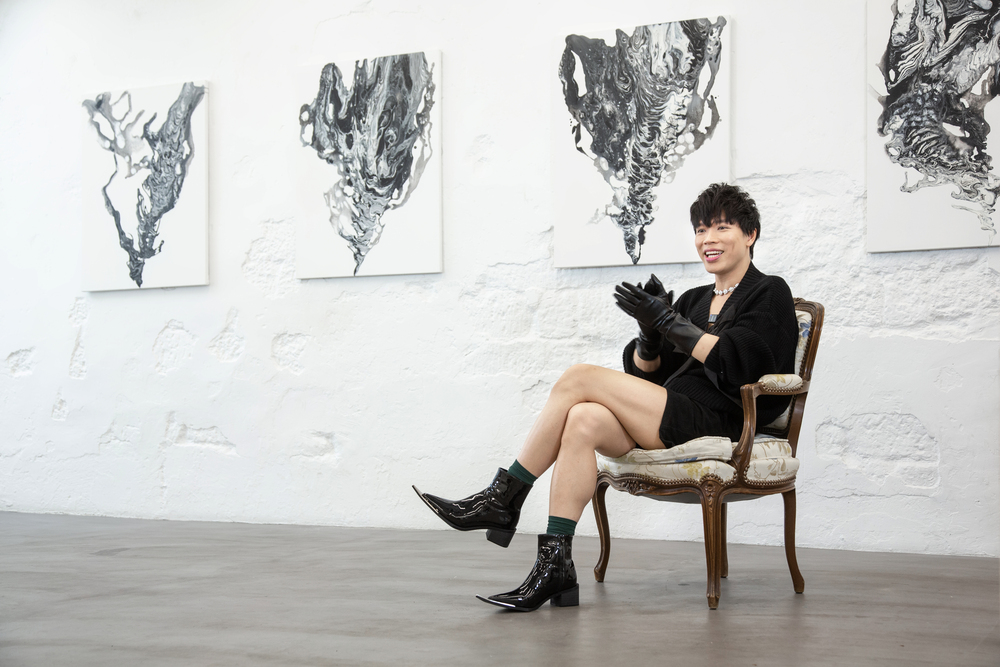
Hong Kong-born, Paris-based artist Wallace Woo concludes a landmark solo exhibition that has sparked genuine debate across the European art world, introducing a movement that trades speed for depth, and ego for earth.
What does it mean to slow down in an era that mistakes velocity for vision? Wallace Woo has an answer, a lifetime of learning what it means to be.
With the successful close of his solo exhibition in Paris this June, Woo has done more than present paintings. He has introduced Geological Abstractionism, a fully articulated aesthetic system born not from trend or theory, but from nearly two decades of quiet, disciplined practice. The European art world has taken notice.

From Eruption to Excavation
Where 20th-century Western abstraction was driven by emotional eruption and the violent assertion of self, Woo’s practice moves in the opposite direction. He relinquishes control, inviting gravity, time, and the slow sedimentation of matter to become co-authors of each work. Paint dries in layers over months. Each stratum holds a memory. The finished canvas is less a statement than a geological record.
“Art history should not be dominated by a single civilisation,” Woo has said. “The soul of Asian art possesses the energy to create a new narrative, we no longer need to seek outward; we only need to excavate inward.”
This is not a rejection of Western art history but a confident expansion of it, positioning Eastern Zen philosophy and “Inner Geology” as generative forces for contemporary aesthetics rather than appendages to it.

The Chamber of Silence: A Room That Does Something
The centrepiece of the exhibition was a spatial intervention Woo calls the “Chamber of Silence”, a stripped-back room housing a single painting in confrontation with his Tibetan documentary work. Visitors described stepping inside as a form of involuntary decompression: the ambient noise of the city and the digital world cut away, leaving only the work and the viewer.
“We live in an era that mistakes ‘speed’ for ‘progress,'” Woo explains. “This chamber is a rebellion to reclaim a genuine sense of existence.”

A Living Archive: The Exhibition as Collective Testimony
In an unusual gesture, the gallery walls became a collecting ground for visitors’ written reflections. Hundreds of responses, from artists, academics, and first-time gallery visitors, will be published alongside interdisciplinary dialogues between Woo and a geologist, archaeologist, and glaciologist in the second edition of his monograph, “Stalactite – The Clamorous Stillness” (ISBN: 978-988-71890-0-8).
The result is a cross-disciplinary archive that refuses the usual hierarchy between art world insiders and the general public, a “collective testimony,” as Woo puts it, for a noisy civilisation.

What Comes Next
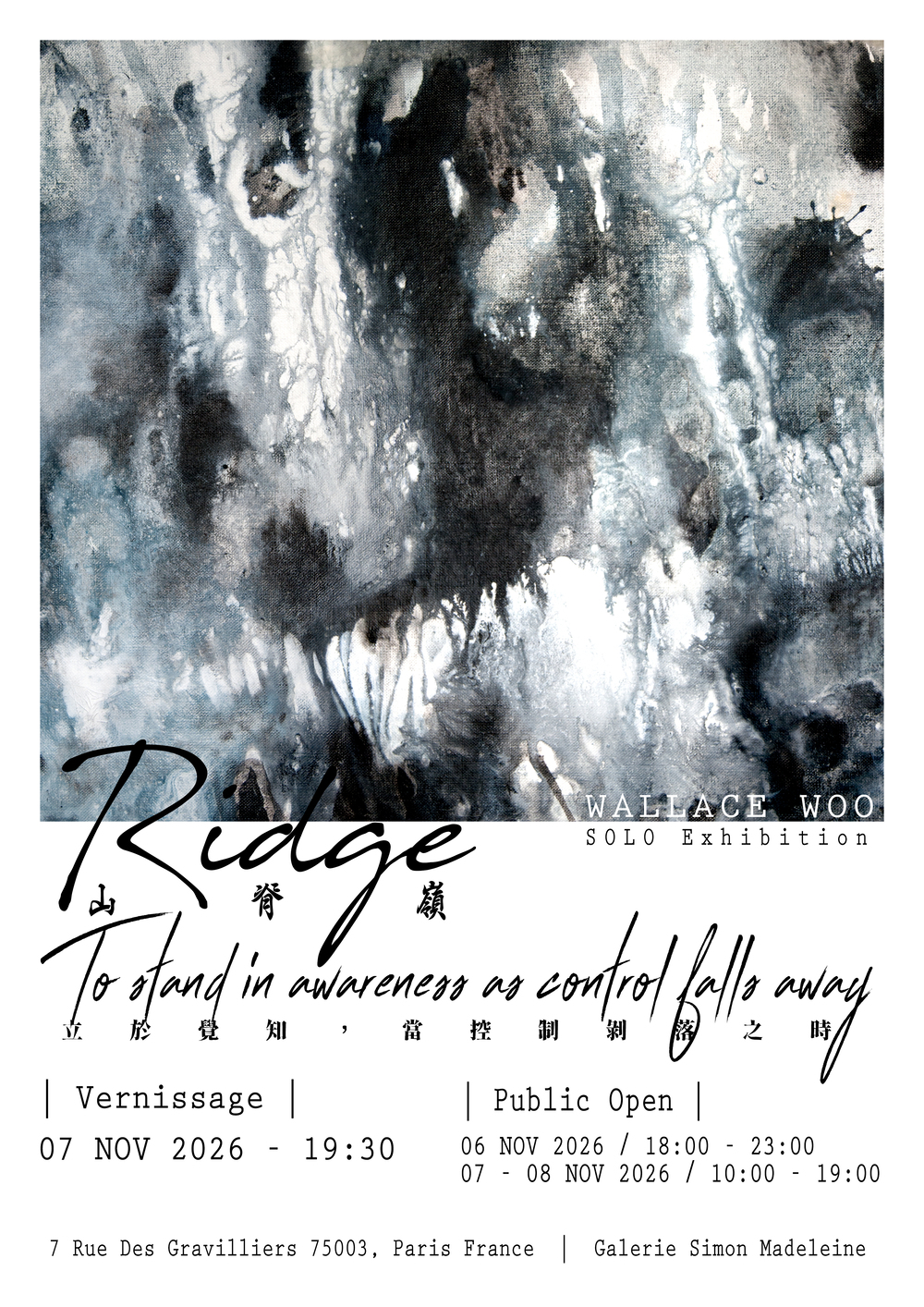
The Paris exhibition is the opening chapter of a wider international mission. From 6 to 8 November 2026, Woo unveils a new series in Paris: “Ridge : To stand in awareness as control falls away”, a continuation of his inquiry into time, matter, and the act of letting go.
About Wallace Woo
Born in Hong Kong and based in Paris, Wallace Woo is a contemporary artist whose practice integrates Eastern Zen philosophy with his own concept of “Inner Geology.” His work transforms lived experience into layered visual records, conspiring with gravity and time to construct a unique aesthetic narrative. He is the founder of Geological Abstractionism.
Credit:
Photographer: Alejandra Gomez / Gallery & Portrait Anis Chehri / Vernissage
Videographer by Raphaël Aupy
Retro Chic / Jewelry Sponsor


Nicoleta Raicu
Latest posts by Nicoleta Raicu (see all)
- GUSTAFFSON: “Bring Back the Truth of Real Risk-Taking Songwriting” - October 13, 2026
- Inside “Re/form”, Collected XX’s Take on Tradition - September 24, 2026
- Diana Boariu: From Behind the Lens to Between the Lines - July 30, 2026