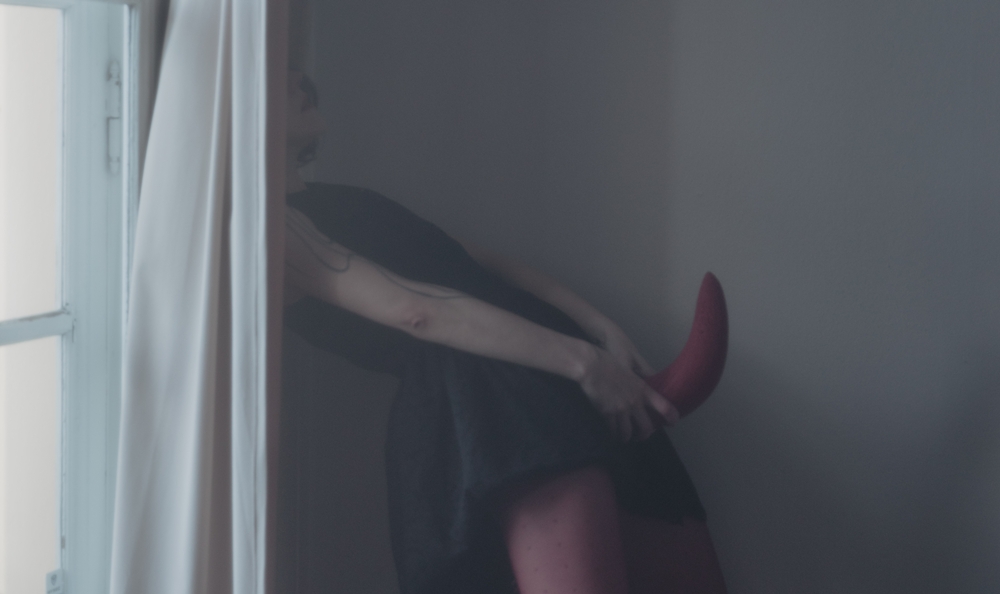
Ekaterina Iakiamseva moves through photography with the instinct of someone who distrusts surfaces. The image, for her, is never a simple record, never an obedient witness. It becomes a site of tension, a controlled disturbance where the visible is pushed to the edge of collapse. Light functions as a governing force, not as embellishment, shaping temporary worlds that exist only for the duration of a breath, a flicker, a particular hour of the day when reality seems briefly undecided.
Her self-portraiture avoids the predictable gravitational pull of identity. The frame holds her presence, yet refuses to stabilize it. She appears as a figure caught between states: partially erased, partially transformed, suspended in a private metamorphosis. A face turns into a blur, a gesture becomes a symbol, a silhouette starts to resemble a memory rather than a body. The intimacy remains, yet it is filtered through abstraction, like a confession spoken through fog.
This practice thrives at the border where presence and disappearance meet, where the world is still recognizable but no longer trustworthy. Iakiamseva does not seek definition; she seeks resonance. Her photographs carry a quiet violence, the kind that happens when something familiar is forced to reveal its hidden anatomy. The viewer is not guided toward admiration, nor toward comprehension. The work invites an internal encounter, a slow confrontation with whatever remains unspoken inside the observer.
In this sense, her images function as visual narratives built from fractures. They live between imagination and raw reality, between the surreal and the brutally tangible. The objects she uses, the rooms she inhabits, the shadows that fall without warning, everything becomes part of a choreography where the world itself appears to participate. Space is never passive in her work; it reacts, it presses back, it rearranges itself around her presence.
The series “I Thought There Was Love in The Air, But it Was a Gunpowder” intensifies this sensation, as if the atmosphere surrounding the artist thickened into a substance that could be shaped. The photographs feel charged with an invisible accumulation, as though something beyond intention gathered in the room and demanded to be translated into form. As Ekaterina describes it: “There was something special about this shooting, like all the space around me was collecting all the energies together to make it happen.”


That statement carries the logic of ritual rather than production. The process seems guided by a sensitivity to signals: the subtle pull of an object, the sudden insistence of a shadow, the strange authority of a corner illuminated in an unexpected way. A mundane element can become a trigger, a key capable of unlocking an entirely different narrative. The transformation begins long before the shutter closes.
Her relationship with objects is deeply instinctual, almost animistic, as if each material presence holds its own dormant mythology. She searches for something that speaks, something capable of generating a story through contact. In her words: “I was looking for an odd, strange object that spoke to me, something to play with and create a story with its help. Of course, all objects transform in my hands, playing their role together with me. This time it was the horn. I already had the tights in my bag and the dress, a piece of red fabric, and now the horn was in my arm and I already knew what I was going to do. I went and bought the paint to color the horn and… yes! All the space sparkled, so I felt it was right.”


The horn enters the scene as an intrusion, a foreign body that changes the temperature of everything around it. The red fabric carries an unmistakable pulse, not romantic but visceral, closer to a wound than a decoration. Even the act of painting becomes part of the narrative, a gesture that seals intention into matter. There is a sense that the story is not invented but summoned, coaxed out of space through touch and attention.


The location itself expands beyond expectation. What was meant to happen in one room becomes something larger, more labyrinthine, as though the work demanded a different architecture to unfold properly. Ekaterina notes this shift directly: “Later the shooting happened. It was supposed to be another room, absolutely different, but I got almost all the palace rooms to make it all come to reality.”
The mention of palace rooms introduces an almost spectral dimension. Such spaces carry their own weight; echoes of grandeur, histories embedded into walls, ceilings that have witnessed lives unfolding beneath them. To place a self-portrait within such an environment is to allow the body to collide with memory on a monumental scale. The personal becomes strange, and the strange becomes intimate.
Ekaterina’s photography operates as something closer to performance, a form of embodied listening where the room dictates as much as the artist does. She does not treat the image as a finished object, but as a trace of an event, something that happened between herself and the atmosphere surrounding her. She articulates this precisely: “My photography, it’s self-portraits, is not exactly photography. This is more like a performance. I explore the space and myself in the energies I’m transmitting in the moment and the energies collected for this moment, and I try to listen to what is around…”

This approach creates a specific kind of tension: the sensation that the photograph holds a residue, a psychic afterimage of something that cannot be fully explained. The title “I Thought There Was Love in The Air, But it Was a Gunpowder” appears tender at first glance, almost weightless, yet the series refuses to remain inside that softness. Something volatile lingers beneath the surface. Ekaterina captures this rupture in a line that feels like an epiphany: “Like, ‘I thought there was love in the air, but it was gunpowder.’”
That single sentence reconfigures the entire series. Love becomes unstable, not as melodrama, but as chemistry. Desire turns combustible. Beauty turns suspicious. The photographs begin to read like quiet detonations, moments where the viewer senses that something has already been set in motion, something irreversible, something that cannot be undone by aesthetic pleasure.
What emerges from Iakiamseva’s work is a refusal of stagnation. Her vision insists on movement, on vulnerability, on surrendering control to whatever is alive inside the moment. The photograph becomes a living surface, open to transformation, shaped by instinct and risk rather than certainty. She rejects novelty as a decorative ambition, choosing instead an openness that allows the medium to mutate organically, free from hesitation and self-censorship.
Ultimately, Ekaterina Iakiamseva’s self-portraits refuse the logic of reflection, operating instead as passageways into a more private and unstable terrain. They pull the viewer away from passive observation and toward a more intimate form of recognition, the kind that arrives unexpectedly, quietly, and leaves behind a sensation of having entered a room within oneself that had remained locked for far too long.


Follow Ekaterina Iakiamseva on:
Instagram
© All rights reserved to Ekaterina Iakiamseva

Nicolae Baldovin
Latest posts by Nicolae Baldovin (see all)
- WU-TANG Legend Ghostface Killah Sets Two Shows in Russia - October 23, 2026
- A Little Skin, a Little Sin, and a Lot of Chaos - October 19, 2026
- “The Disciple: A Wu-Tang Fable” Arrives on Netflix This October - October 15, 2026