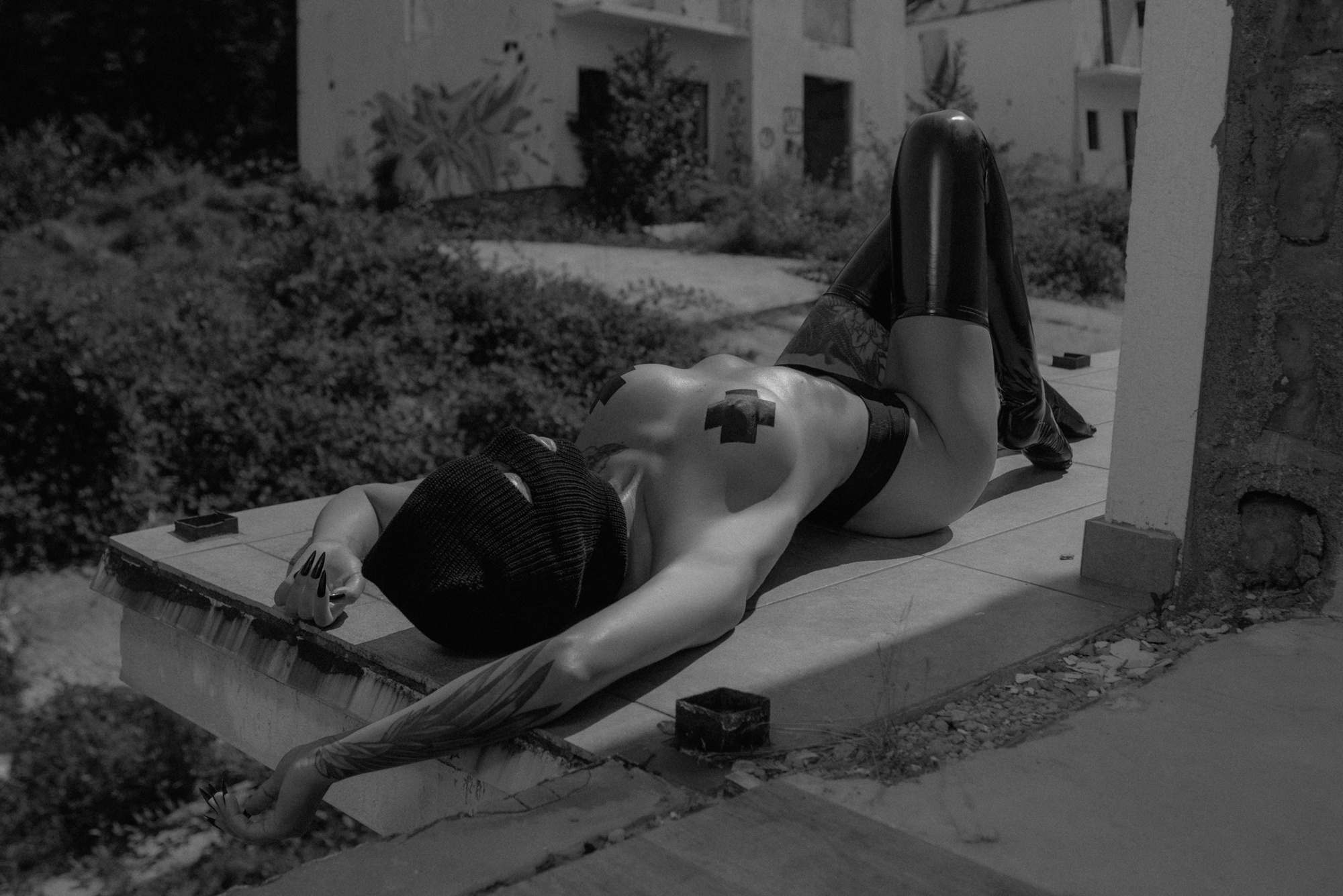
Evgeny Batievsky belongs to that rare category of artists whose creative language refuses to remain within a single discipline. Based in Sochi, the Russian photographer moves between visual storytelling, sound engineering and DJ culture, carrying something from each field into the next. Rhythm, atmosphere, tension and silence find their way into his images, giving his work an almost cinematic pulse. His photographs frequently inhabit the territory of the nude, yet the body is only one element within a much larger narrative, a presence through which unfamiliar worlds begin to take shape.


Batievsky’s aesthetic is grounded in restraint. Natural light, honest colour and the physical character of real environments provide the foundations of his compositions. His images retain traces of the places where they were made, allowing walls, concrete, weathered surfaces and imperfect textures to remain visible. Excessive retouching has little purpose in this universe. The photograph is allowed to preserve its own evidence: the atmosphere of a room, the grain of a surface, the particular quality of daylight falling through an empty structure. Reality remains present in all its unfinished detail.
The series presented here enters a darker register. Alexandra Vagner becomes its central figure, inhabiting an abandoned industrial building where only fragments of architecture remain intact. Concrete walls, exposed staircases and vast stretches of emptiness create a setting suspended somewhere beyond ordinary chronology. There is no elaborate construction surrounding her, no artificial machinery designed to manufacture a dystopian mood. The environment already carries its own history. Batievsky simply listens to it.


Leather garments introduce another layer into the narrative, bringing the imagery towards the visual territory of BDSM, goth and industrial culture. The connection feels particularly natural within Batievsky’s broader artistic universe, where music and photography seem to share an instinct for rhythm, atmosphere and controlled intensity. The clothing becomes part of the architecture, its texture responding to the concrete, its darker presence establishing a visual tension against the pale surfaces and open spaces. Nothing feels ornamental. Each element has a reason to remain within the frame.
Alexandra gives the series its human centre. Her performance possesses an unusual composure, allowing the abandoned surroundings to remain imposing without swallowing her presence. She moves through the space with a measured confidence, carrying the atmosphere rather than merely occupying it. Her expressions remain restrained, her gestures precise, and the emotional temperature of the photographs develops through accumulation: a staircase, a fragment of wall, a stretch of skin, a shadow, a moment of stillness.


There is something almost post-apocalyptic in the resulting imagery, although the photographs never depend on spectacle. The world appears to have been emptied of its previous inhabitants, leaving behind only architecture and one solitary figure moving through its remains. The absence of dramatic effects makes the setting more convincing. What emerges is a dystopian landscape produced entirely through circumstance, light and imagination.
This is where Batievsky’s background in sound becomes especially interesting. His photographs seem to contain an inaudible soundtrack: the echo of footsteps across concrete, distant machinery that no longer functions, the faint resonance of an empty stairwell. Alexandra’s presence introduces the human frequency into that silence. The image begins to feel less like a fixed scene and more like a fragment taken from a film that continues somewhere beyond the frame.
The value of the series ultimately rests in that unfinished quality. Batievsky leaves enough space for the viewer to construct what cannot be seen. There is no predetermined ending, no elaborate mythology imposed upon the photographs. The story remains open, moving quietly between the physical world and the private cinema of the mind. In an era increasingly saturated with artificial surfaces, perfected bodies and images engineered to exhaustion, his work preserves something increasingly precious: the freedom of a photograph to remain real, incomplete and alive inside the imagination.


© All rights reserved to Evgeny Batievsky.

Nicolae Baldovin
Latest posts by Nicolae Baldovin (see all)
- Awe Inspired Summons Mythology for “Nocturne” - September 29, 2026
- Johnny Depp’s “Day Drinker” Just Got Its First Trailer - September 29, 2026
- Brad Pitt Returns as Cliff Booth in New Netflix Film - September 29, 2026