Diego Barrera moves between Mexico City and Berlin carrying an interesting intellectual baggage. Germanic and Slavic linguistics on one side, a doctorate in theology on the other, yet in his case, none of it feels ornamental or distant.
It seeps into the work in a way that’s almost structural, as if systems of belief and language have been stripped of abstraction and forced to operate directly on matter, on the body, on gesture. There’s a sense that what he builds isn’t just visual, but encoded, layered with the kinds of tensions that come from thinking deeply about how meaning gets constructed, imposed, and absorbed.


Art of Akume, the project he works through, complicates authorship even further. “Akume” isn’t a persona or an alter ego in the usual sense, but something assembled, a composite body made out of fragments, references, contradictions. It behaves like a container where cultural influences don’t blend into harmony but remain in friction, where appropriation isn’t hidden but exposed as part of the mechanism.
Mexican Catholic baroque excess collides with Japanese and Slavic traces, and instead of resolving into a unified language, they stay slightly misaligned, producing that constant low-level tension you can feel across the work.


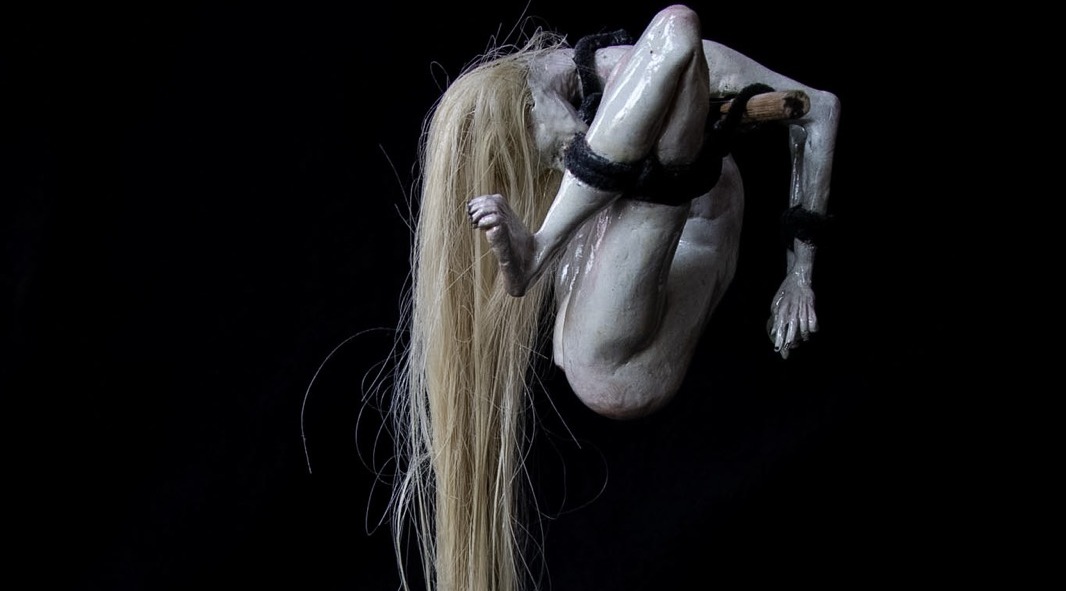
Akume feels like something that shouldn’t quite hold together, and yet somehow does, in that tense, almost uncomfortable way certain objects refuse to fall apart even when everything in them suggests they might. The figures behave more like situations you walk into, charged, unstable, already unfolding without you. There’s a kind of density to them, not just in the materials, but in the way they carry references, gestures, and tensions that never fully settle into a single meaning.
Knowing that Diego Barrera comes to this through linguistics and theology makes a certain kind of sense, although the work never illustrates those backgrounds in any direct way. Instead, it feels like those disciplines have been broken down and reassembled into something more physical, where belief systems, language structures, and cultural codes stop behaving as abstract frameworks and start acting directly on the body.


The project itself, Art of Akume, functions less like an identity and more like a constructed entity, a kind of composite that can absorb contradictions without needing to resolve them.
The mix of references, Mexican Catholic baroque, Japanese and Slavic elements, never smooths itself into a coherent aesthetic language. You can sense the friction in the way forms are assembled, in the way surfaces carry both care and aggression, in how beauty keeps sliding into something harsher, something that resists being comfortably categorized.


What keeps the work from slipping into pure spectacle is the way it handles intensity. The themes circling it, sex, religion, violence, don’t appear as topics lined up for interpretation, but feel embedded in the structure of the pieces, shaping how bodies are posed, bound, extended, or held in place. Violence, in that sense, spreads out beyond the obvious, touching the symbolic and the psychological, the way something gets imposed, repeated, internalized.
Spending time with these works leaves you in a slightly altered state, somewhere between attraction and unease, where the instinct to decode gives way to a more physical kind of engagement.


Follow Art of Akume on:
Website | Instagram


Nicoleta Raicu
Latest posts by Nicoleta Raicu (see all)
- GUSTAFFSON: “Bring Back the Truth of Real Risk-Taking Songwriting” - October 13, 2026
- Inside “Re/form”, Collected XX’s Take on Tradition - September 24, 2026
- Diana Boariu: From Behind the Lens to Between the Lines - July 30, 2026